

How to Start a Direct Selling Company Legally in India: Step-by-Step Compliance Guide (2026)
Introduction
A direct selling compensation plan is more than a method of calculating commissions. It is a key part of the company's legal and operational framework because the way distributors are rewarded can determine whether the business model supports genuine product sales or creates risks associated with pyramid-scheme or money-circulation structures.
In India, direct selling businesses need to design their compensation plans with the Consumer Protection (Direct Selling) Rules, 2021, as amended in 2023, in mind. The Department of Consumer Affairs officially lists both the 2021 Rules and the 2023 Amendment Rules under the Consumer Protection Act, 2019.
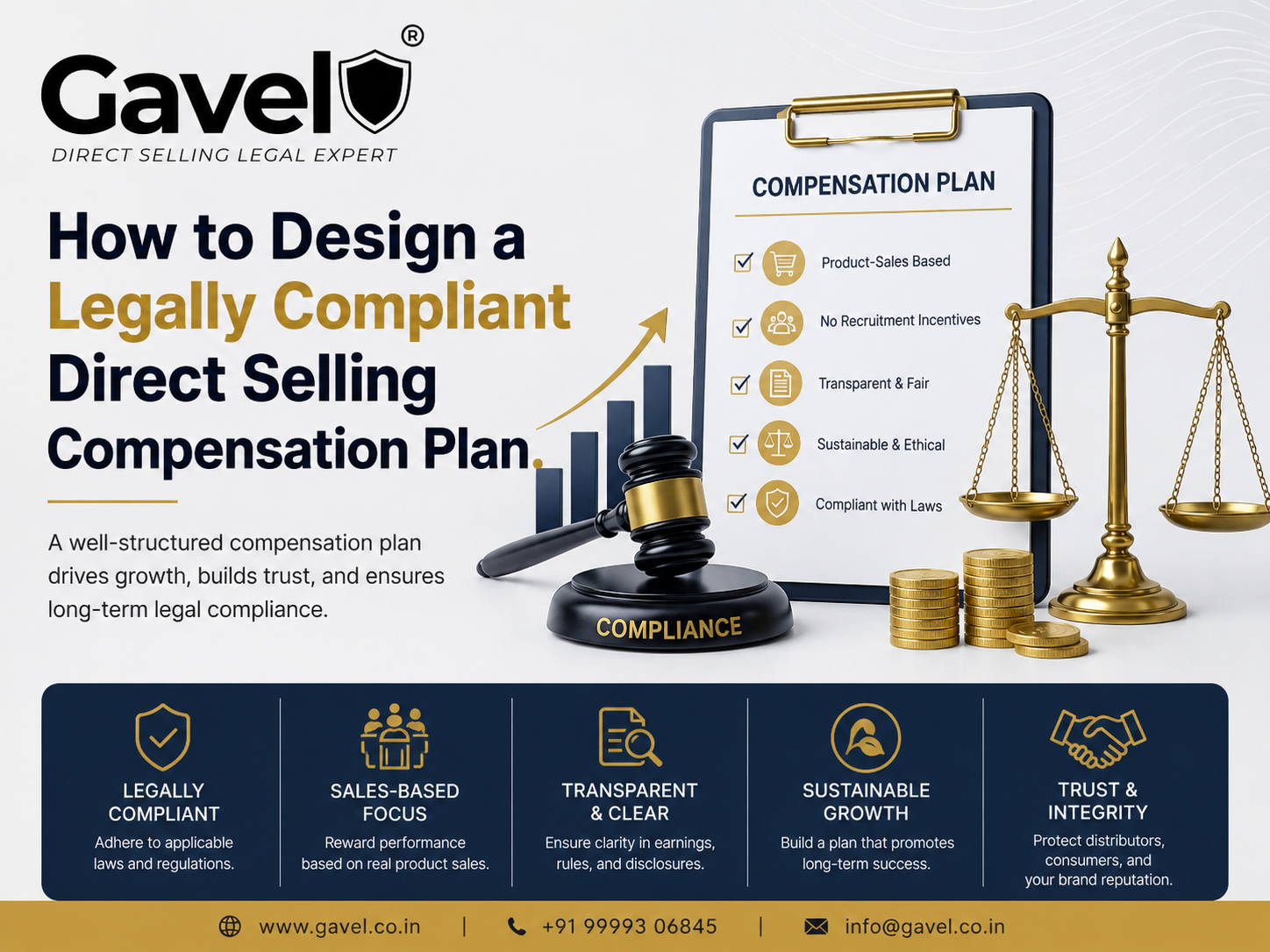
A compliant compensation plan should therefore reward legitimate sales and business activity, maintain transparency, avoid recruitment-driven incentives, and provide clear information about how distributors can earn.
1. Start With Genuine Product Sales
The foundation of a compliant direct selling compensation plan should be the sale of genuine products or services to consumers.
Commissions should be linked to legitimate commercial activity rather than simply to bringing new people into the network.
A company should clearly define:
- What qualifies as a commissionable sale
- Whether the sale is to an end consumer or distributor
- The applicable commission percentage
- Qualification requirements
- Payment cycles
- Returns and cancellation treatment
- Conditions for bonuses and incentives
The compensation structure should make economic sense even without continuous recruitment of new participants.
2. Avoid Recruitment-Based Earnings
One of the most important compliance considerations is preventing the compensation plan from becoming recruitment-driven.
A risky structure may provide substantial rewards merely because a distributor:
- Enrols a new participant
- Receives an entry fee or joining payment
- Encourages participants to purchase products primarily to qualify for commissions
- Earns predominantly from the payments or purchases of recruited participants
Instead, incentives should be connected to genuine product sales, customer development, and measurable business performance.
3. Do Not Create Pyramid-Scheme Characteristics
The compensation plan should be reviewed specifically for characteristics that could make the business resemble a pyramid scheme.
Before launch, the company should ask:
Can a distributor earn meaningful income primarily by recruiting people rather than selling products?
If the answer is yes, the structure requires careful legal review.
The plan should demonstrate that products have genuine value and that commissions are generated through legitimate commercial transactions.
4. Structure Commissions Around Verifiable Sales
A strong compliance-oriented model can use clearly defined sales metrics such as:
- Retail sales
- Verified customer orders
- Net sales after returns
- Customer retention
- Product-specific sales targets
- Team sales generated from genuine customer demand
For example, instead of paying a large bonus merely for enrolling 20 distributors, a company may structure incentives around verified net product sales generated over a defined period.
This makes the commercial basis of the compensation easier to document and audit.
5. Carefully Design Incentives and Bonuses
Bonuses are not inherently problematic, but their eligibility conditions should be carefully drafted.
Every bonus should answer three questions:
- What activity generates the bonus?
- How is the bonus calculated?
- What happens when the underlying transaction is cancelled or refunded?
For example, if a distributor receives a sales bonus based on ₹1,00,000 of qualifying sales and ₹20,000 is subsequently refunded, the company should have a clearly documented mechanism for adjusting the commission where applicable.
This can help prevent overpayment and maintain accurate compensation records.
6. Include Refund and Clawback Mechanisms
Returns, cancellations, refunds and chargebacks can directly affect commissions.
A compensation plan should therefore specify how commissions are treated when:
- A customer returns a product
- An order is cancelled
- A payment is reversed
- A transaction is fraudulent
- A distributor violates company policies
- A qualifying sale is subsequently determined to be invalid
A properly drafted clawback or adjustment mechanism can help ensure that commissions are based on genuine, completed and eligible transactions.
7. Prevent Inventory Loading
The company should avoid designing qualification criteria that encourage distributors to purchase excessive inventory simply to achieve a commission or rank.
A compliance review should examine:
- Minimum purchase requirements
- Monthly qualification volumes
- Rank-maintenance requirements
- Product stocking requirements
- Auto-order arrangements
- Incentives connected to distributor purchases
The objective should be to encourage real market demand, not artificial purchasing by participants.
8. Make Earnings Calculations Transparent
Distributors should be able to understand how their compensation is calculated.
The company should provide a written compensation plan explaining:
- Commission percentages
- Bonus categories
- Qualification criteria
- Rank requirements
- Performance periods
- Payment schedules
- Eligible sales
- Excluded transactions
- Refund adjustments
- Applicable taxes or deductions
Complex compensation plans should also include practical examples so that distributors do not misunderstand the earning opportunity.
9. Control Income and Earnings Claims
A legally compliant compensation plan can still create risk if distributors make misleading earnings claims.
Statements such as:
- "Earn ₹1 lakh every month"
- "Guaranteed income"
- "Quit your job in six months"
- "Anyone can become financially independent"
should not be made without appropriate substantiation and context.
The company's compliance program should establish rules for social-media posts, presentations, testimonials, WhatsApp messages, videos and other distributor communications.
The Department of Consumer Affairs also lists the Guidelines for Prevention of Misleading Advertisements and Endorsements for Misleading Advertisements, 2022, making advertising and earnings-claim controls an important part of the wider compliance framework.
10. Document the Compensation Plan Before Launch
The compensation plan should not exist only as a presentation or sales-training document.
The company should maintain formal documentation covering:
- Compensation-plan rules
- Definitions of commissionable sales
- Bonus calculations
- Distributor eligibility
- Refund and clawback rules
- Rank and qualification criteria
- Prohibited activities
- Earnings-disclosure requirements
- Compliance approval
- Version history and amendments
The Department of Consumer Affairs maintains the Consumer Protection (Direct Selling) Rules, 2021 and related rules and amendments on its official website.
11. Conduct a Pre-Launch Legal Compliance Test
Before introducing a new compensation plan, companies should conduct a structured legal review.
A practical review can include:
Product Test:
Are commissions ultimately connected to genuine products or services?
Sales Test:
Can the plan function through genuine consumer sales?
Recruitment Test:
Are participants rewarded primarily for recruitment?
Inventory Test:
Could qualification requirements encourage excessive purchases?
Transparency Test:
Can an ordinary distributor understand how compensation is calculated?
Refund Test:
Are commissions adjusted when qualifying transactions are returned or cancelled?
Marketing Test:
Are income claims controlled and properly substantiated?
Documentation Test:
Are the compensation rules, distributor agreements and policies consistent?
12. Review the Plan Periodically
A compensation plan should not be treated as a one-time legal exercise.
Companies should periodically review:
- Changes in applicable laws and rules
- Commission trends
- Distributor complaints
- Refund rates
- Recruitment patterns
- Product-sales ratios
- Earnings claims
- Distributor conduct
- Changes to products or pricing
- Changes to incentive programs
The Department of Consumer Affairs currently lists the 2021 Direct Selling Rules and the 2023 Amendment Rules among the rules made under the Consumer Protection Act, 2019.
Conclusion
A legally compliant direct selling compensation plan should be built around genuine product sales, transparent calculations, responsible incentives and strong consumer protection controls.
The most important principle is simple: the compensation structure should reward legitimate business activity rather than making recruitment the primary source of earnings.
Companies should also ensure that the compensation plan, distributor agreement, refund policy, marketing materials and compliance procedures work together as one consistent framework.
Because the legal and regulatory position can change and the appropriate structure depends on the company's products, operations and business model, businesses should obtain a current legal review before launching or materially changing a compensation plan.



.png)